
ISRO launched the XPoSat, its first X-Ray Polarimeter Satellite, from the Satish Dhawan Space Centre in Sriharikota, Andhra Pradesh.
The Indian Space Research Organisation achieved success by launching India’s inaugural X-Ray Polarimeter Satellite, XPoSat, providing valuable insights into celestial objects such as black holes. The ISRO deployed XPoSat into Low Earth Orbit using the PSLV-C58 rocket during its 60th mission from the Satish Dhawan Space Centre in Sriharikota on Monday.
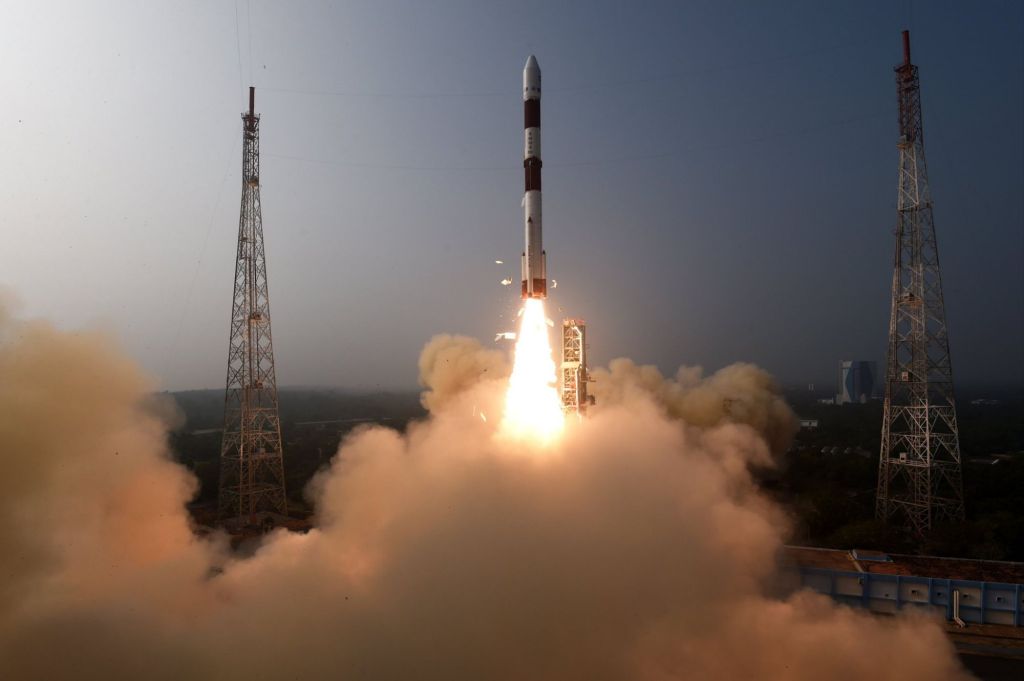
At 9:10 am on January 1, the PSLV-C58 rocket launched from the first launch pad at the spaceport, situated approximately 135 km east of Chennai.
The ISRO’s first dedicated scientific satellite is conducting research on space-based polarization measurements of X-ray emission from celestial sources.
In December 2021, the US-based National Aeronautics Space Agency (NASA) performed a similar study with the Imaging X-Ray Polarimetry Explorer mission, exploring remnants of supernova explosions, particle streams emitted by black holes, and other cosmic events.
Monday’s mission is a significant value-addition to the scientific fraternity, marking a milestone in space-based X-ray astronomy in India, focusing on imaging and time domain studies, according to the space agency.
PSLV-C58 Mission’s Goal: Launching XPoSat for Pioneering X-ray Astronomy Research
– Measure polarization of X-rays in the 8-30 keV energy band from approximately 50 potential cosmic sources.
– Conduct long-term spectral and temporal studies of cosmic X-ray sources.
– Utilize X-ray polarization as a diagnostic tool to examine the radiation mechanism and geometry of celestial sources.
– Feature primary payload XPoSat, housing POLIX (Polarimeter Instrument in X-Rays) designed by Raman Research Institute.
– Include XSPECT (X-ray Spectroscopy and Timing), developed by the U R Rao Satellite Centre, Bengaluru.
ISRO kicked off the New Year by launching its inaugural X-Ray Polarimeter Satellite, following the successful Gaganyaan Test Vehicle D1 mission in October.
In a remarkable display of prowess, India achieved new heights in 2023 by successfully executing the soft landing of Chandrayaan-3 on the south pole of the Moon and launching Aditya-L1, India’s inaugural solar mission.
Chandrayaan-3, the country’s first triumphant lunar landing mission, aimed to demonstrate a soft landing near the lunar south polar region and conduct experiments using the instruments onboard the lander ‘Vikram’ and rover ‘Pragyaan’.
On August 23, the Vikram Lander accomplished its historic touchdown on the Moon, followed by the deployment of the Pragyan rover to survey the uncharted lunar south pole.
India now actively pursues several feats, including the Gaganyaan Mission, the establishment of the ‘Bharatiya Antariksha Station’ by 2035, and achieving the milestone of sending the first Indian to the Moon by 2040.
 Artistic Blog